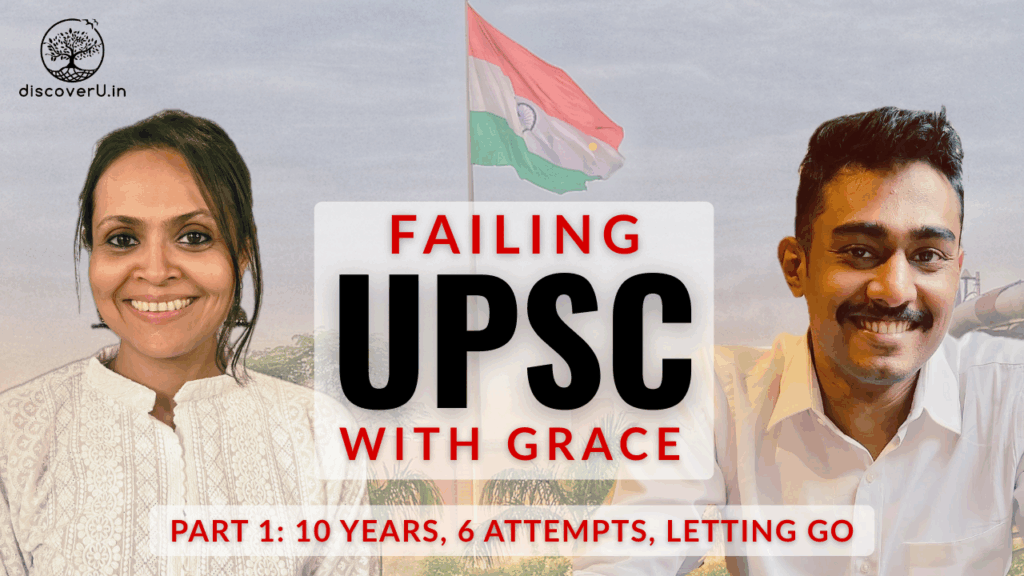
“Once an aspirant, always an aspirant,” says Rushikesh Ganesh Kulkarni, reflecting on a decade-long journey that began with dreams of civil service and led him to a fulfilling career in human resources.
Today, Rushikesh is the Senior Manager – HR Business Partner for Engineering and Product at CleverTap, a leading martech company. A lifelong Mumbaikar and TISS alumnus, he brings seven years of experience in HR, having previously worked with Samsung R&D in Bangalore and Pine Labs in Mumbai.
But before HR and corporate life, there was the UPSC dream—a dream that spanned over ten years, multiple attempts, countless sacrifices, and eventually, the acceptance of a different path forward.
In this conversation with DiscoverU founder and career coach Nahida Coelho, Rushikesh opens up about the highs and heartbreaks of UPSC prep, the emotional toll of repeated failures, and the wisdom he wishes he had when he first started out.
Q&A with Rushikesh Kulkarni
1. What made you pursue the UPSC Civil Services Examination in the first place?
I grew up seeing civil servants make real, visible changes in society, and that left a mark on me. UPSC wasn’t just a prestigious exam — it felt like the path to meaningful impact. The idea that you could influence policy, solve ground-level problems, and improve lives was powerful. At the time, I also didn’t want a routine corporate career; I wanted work that had purpose. So UPSC became that dream, and once I decided, I gave it everything I had.
2. You wrote that UPSC taught you to “fail with grace.” What do you mean by that?
When you start, you think hard work guarantees success. But UPSC humbles you. It doesn’t matter if you were a topper in school or college — this exam can break that self-image overnight. My first failure hit hard. I remember feeling like the ground had shifted beneath me. But over time, I realized failure isn’t the end; it’s data. It teaches you where you fell short — whether in strategy, mindset, or execution. Failing with grace means learning without bitterness, showing up again without self-pity, and not letting one result define you. That lesson has stayed with me beyond the exam.
3. Ten years. Multiple attempts. What kept you going despite so many setbacks?
Honestly, every failure made me question things. But what kept me going was this mix of hope and stubbornness. Also, each attempt taught me something new — not just academically, but about myself. I learned discipline, patience, and the ability to focus deeply for months at a stretch. My motivation evolved too. Initially, it was about clearing the exam; later, it became about seeing how far I could push myself despite the odds. That shift made the journey meaningful even without the result I had hoped for.
4. How did you handle the mental pressure during this long journey?
The pressure was intense. Everyone around you moves on with their careers while you’re stuck in this preparation loop. What helped was building small routines to stay sane — exercise, reading non-UPSC books, spending time with people outside the exam bubble. And I can’t stress enough the importance of a support system. Friends and family who didn’t judge me by my results kept me grounded when I felt like giving up.
5. At what point did you decide to move on from UPSC, and how was that transition?
After my last attempt, I had this moment of clarity: I didn’t want to spend another five years chasing one outcome. Letting go wasn’t easy — it felt like giving up on a dream. But slowly, I realized my life was bigger than one exam. I started looking at roles in the corporate sector, and to my surprise, a lot of what I learned during UPSC — writing clearly, analyzing complex information, thinking critically — helped me stand out. The transition was challenging but also liberating because I wasn’t defined by a single career path anymore.
6. Looking back, what’s your biggest takeaway from those 10 years?
That failure is part of success, not the opposite of it. UPSC taught me resilience, self-awareness, and humility. If I had cleared in my first attempt, I might not have learned any of this. Those ten years shaped how I approach challenges even today — with patience, perspective, and the ability to start over when things don’t go as planned.
Key Learnings
Failing with grace builds resilience
Repeated setbacks taught Rushikesh to accept failure without losing confidence — a skill that transcends exams and careers.
Motivation evolves over time
What started as a goal to clear the UPSC became a personal journey of self-improvement and discipline.
A support system is non-negotiable
Friends, family, and mentors provided the perspective and emotional balance needed to survive the pressure.
Skills are transferable beyond UPSC
Critical thinking, communication, and problem-solving built during exam prep became assets in the corporate world.
Identity beyond one goal matters
Moving on from UPSC required reimagining success and not tying self-worth to a single career path.
Rushikesh Kulkarni is a Senior Manager and HR Business Partner for Engineering and Product at CleverTap, a leading martech company, based in Mumbai. He holds an MA in Human Resources from the Tata Institute of Social Sciences (TISS) and brings seven years of post-master’s experience in human resources with a thoughtful, people-first approach in high-growth tech environments. Prior to CleverTap, he served as an HR business partner at Samsung R&D Bangalore and later at Pine Labs in Mumbai, supporting revenue and business teams through crucial phases of growth. A lifelong Mumbaikar, he founded Breakfree Journeys at the age of 19, an initiative he ran until 2016. From 2011 to 2022, he simultaneously pursued the UPSC civil services exam alongside his education and work, a journey that deepened his resilience, discipline, and intellectual curiosity. Outside of work, Rushikesh is passionate about birding, reading, and writing across fiction and non-fiction.