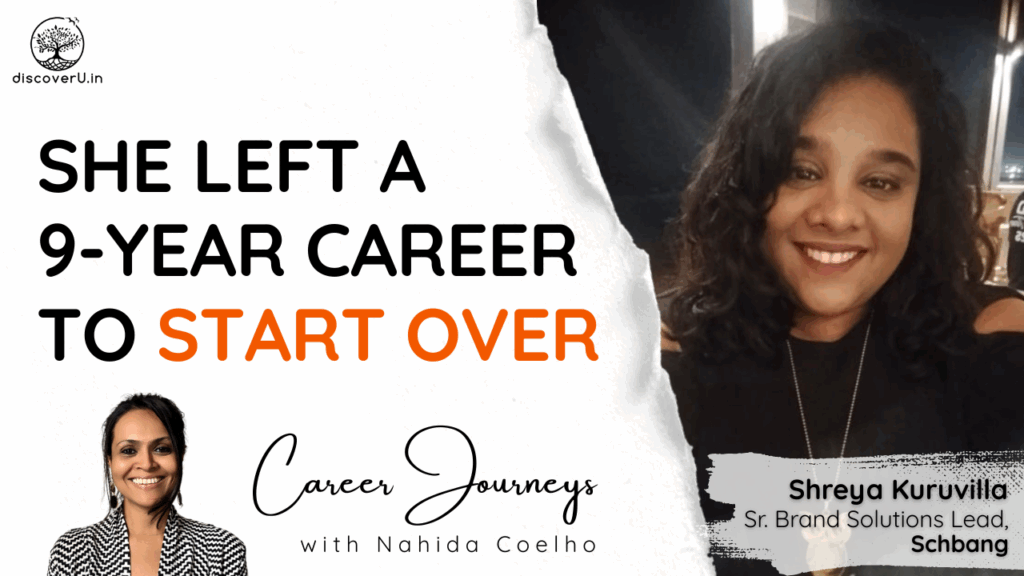
What happens when a History honours graduate trades NCERT textbooks for rural development programs—and then reinvents herself in advertising? In this conversation of DiscoverU Career Journeys, Shreya Maria Kuruvilla shares how her winding path—from St. Stephen’s to WWF India to Schbang—has been powered by one constant: purposeful storytelling. She tells our founder Nahida Coelho:
– Why she chose liberal arts when no one around her did
– What a career in sustainability really looks like (beyond the myths)
– How she discovered storytelling as her core strength
– What it really takes to pivot industries without formal experience
– And how clarity often follows action—not the other way around
Q&A with Shreya Maria Kuruvilla
1: Can you tell us a bit about where you are today in your career journey and what a typical day looks like for you?
I’ve recently transitioned into advertising after spending nine years in the social sector. My workday usually starts between 10 and 10:30 AM, even though the office really starts buzzing around 11. I like getting an early start—it helps me ease into the day by checking emails, responding to messages, and connecting with my team. I’m definitely a people person, so those morning conversations ground me. The latter half of my day is more intense—I shift focus to operational deliverables like approvals, reviews, and clearing action items. I usually wrap up by 7:30 or 8 PM. Once I’m home, I dedicate an hour or so to studying before settling in for dinner and calling it a night.
2: Looking back at your BA in History from St. Stephen’s, what drew you to studying history?
Believe it or not, it all started with a textbook. In the eighth grade, our history textbook wasn’t from NCERT like the rest—it was visually rich and engaging. As I read through it, I didn’t feel like I was studying; it felt like I was diving into layered stories and lived experiences. While many people see history as something to be memorized, for me it was an imaginative, narrative-driven subject. By the time I finished my boards, choosing History Honours felt like the most natural path. It sharpened my critical thinking, helped me analyze experiences from different vantage points, and turned classroom discussions into something genuinely dynamic.
3: Besides your love for storytelling, was there an outcome you were looking for when you chose History as a subject?
Initially, yes. Many of my peers were eyeing academia or the civil services, and I was on a similar path. I studied for the UPSC because I thought it would offer me a chance to work closely with people and impact decision-making early on. But somewhere along the way, I realized what mattered more to me was connecting with people—really understanding their realities. That shift in thinking led me to an internship at WWF India. That’s when I first discovered that the social sector was a viable career path, and not just volunteer work or charity.
4: Was there a family member, mentor, or teacher who influenced your early decisions—especially around journalism or UPSC?
To be honest, journalism was my first instinct because I’ve always loved storytelling and connecting with people. But when I spoke to my family, they weren’t too keen—it felt too “glamorous” to them, and I think they were concerned it wouldn’t be sustainable. I also wasn’t confident enough at the time; I doubted whether I’d be able to think on my feet or make quick decisions. So instead of pursuing what came most naturally to me, I went with what everyone around me was doing—UPSC prep. But it wasn’t really based on advice from a mentor or a family member, just conversations with classmates and peers.
5: Do you feel there were specific misconceptions that held you back from journalism? And do those still exist today?
Absolutely. One major misconception is that you have to be ruthless to survive in journalism—that you have to forget your roots and constantly be on the move or in uncomfortable situations. My family certainly believed that, and to be honest, so did I for a while. But over time, I realized that every field has its challenges. I’ve worked in the social sector and that came with its own form of ruthlessness. It’s not the profession—it’s the commitment and effort you put into your work that defines your experience.
6: For our audience, in one sentence—what is sustainable development?
It’s about applying the concept of sustainability to everything you do—whether it’s a business, a community program, or even a mindset.
7: What motivated you to pursue an MA in Sustainable Development?
What drew me in was the curriculum—it had the right balance of theory and practice. I got to go on field visits, interact with communities, and build research projects from real-world experiences. It wasn’t about securing a specific job; I was excited about the kind of learning this program offered. The chance to study lived realities, not just textbook content, was something I found deeply fulfilling.
8: What kind of roles did you explore during or after your MA? What can someone expect in this space?
Right after my MA, I pushed myself outside my comfort zone. I took up a role in Hardoi, a small town in Uttar Pradesh, where I lived for two years. It was intense—I was working closely with local communities, watching programs unfold right in front of me. That hands-on exposure was both challenging and energizing. Coming from a privileged upbringing in South Delhi, this was a very different world. But I learned so much—how to communicate better, how to understand ground realities, and most importantly, how to adapt.
9: Was there a moment of uncertainty that made you question your path?
Definitely. There were times I felt underpaid and overworked. Sometimes, because of my background or the way I spoke, I felt singled out. But more than anything, I realized I wasn’t able to fully express my creative potential in my role. It wasn’t about a lack of opportunity—it was about misalignment. Whenever a content-related task came up—like organizing an event, designing a flyer, or writing an article—I’d jump at the chance. But that was never the core of my job, and it left me feeling unfulfilled.
10: What steps did you take to transition into branding?
The pivot took time and a lot of self-work. I knew I needed to reconnect with myself, both personally and professionally. That’s when I stumbled upon your profile, Nahida, and our conversations really opened up a new world for me. Until then, I hadn’t even realized that there were so many careers centered around storytelling and content creation. Through our sessions, I began to understand my skillset more clearly. I also realized that I didn’t want to settle for doing something just because it was “safe.” I began networking like never before—messaging people on LinkedIn, not for jobs but just to learn about what they do. That shift in intention was powerful. Eventually, I narrowed down branding as the space where my skills could thrive. And I still feel that energy every day—it’s a space where I’m constantly learning.
11: What were some of the major obstacles in pivoting to brand strategy?
Credibility, for sure. I didn’t have a formal background in media or communications, and I’d spent nine years in a completely different sector. So, I had to build a narrative that showcased my transferable skills—how I had led communication efforts, worked with stakeholders, and created content. There were also doubts—moments where I wondered if this pivot was even possible. Financial concerns crept in too. But I had a long, honest conversation with my husband and decided I’d be willing to take a step back if needed—intern, volunteer, start at entry level. That clarity changed how I approached people and opportunities.
12: Have there been any mindset shifts since joining Schbang?
Yes, several. I’m in an ops-heavy role, which overlaps well with my project management background. But the industry language, the speed, the energy—it was all new. I’ve had to adapt quickly, and I’m still learning. To support this shift, I took up an online course at MICA to build foundational knowledge in branding and advertising. It’s helped me feel more grounded in my new role.
13: What are you currently doing to stay relevant and continue growing in your field?
Interestingly, I’m spending more time on social media—but with purpose. I use it to track trends, understand what’s resonating with people, and apply those insights to my work. Scrolling through Reels isn’t just a distraction anymore—it’s research. I’ve also made it a point to set aside time for myself. Whether it’s journaling or just reflecting, I’ve realized that creativity needs space to breathe. Branding is emotionally intense, and I’ve learned that I need to recharge to show up fully.
Key Takeaways
Your career need not be a straight line
Embrace pivots—from History to social impact to advertising—and trust that each detour builds unique strengths.
Storytelling is your superpower
Whether studying lived histories or designing development programs, narrative skills translate seamlessly into brand communication.
Experiential learning trumps theory alone
Fieldwork in rural communities and hands-on projects surfaced your true motivations and honed practical problem-solving.
Network and experiment early
Informational chats, volunteering or short-term gigs reveal sector realities and help you test new paths before fully committing.
Leap before you feel “ready”
Clarity often follows action—be willing to start entry-level, own your transferable skills and build credibility in a new field.
Shreya Maria Kuruvilla is a Senior Brand Solutions Lead at Schbang, based in Mumbai. She holds a BA (Hons) in History from St. Stephen’s College and a Master’s in Sustainable Development Practices from TERI University. Shreya began her career in the social impact sector, working with organizations like the American India Foundation and Samhita Social Ventures, before transitioning to brand communication and advertising. Her work bridges the worlds of purpose and creativity, driven by a passion for storytelling and strategic content.