Film production is often associated with actors, directors and glamorous film sets. But behind every successful film, series or advertising campaign is a vast network of professionals managing budgets, schedules, logistics, creative decisions, teams and countless unexpected challenges.
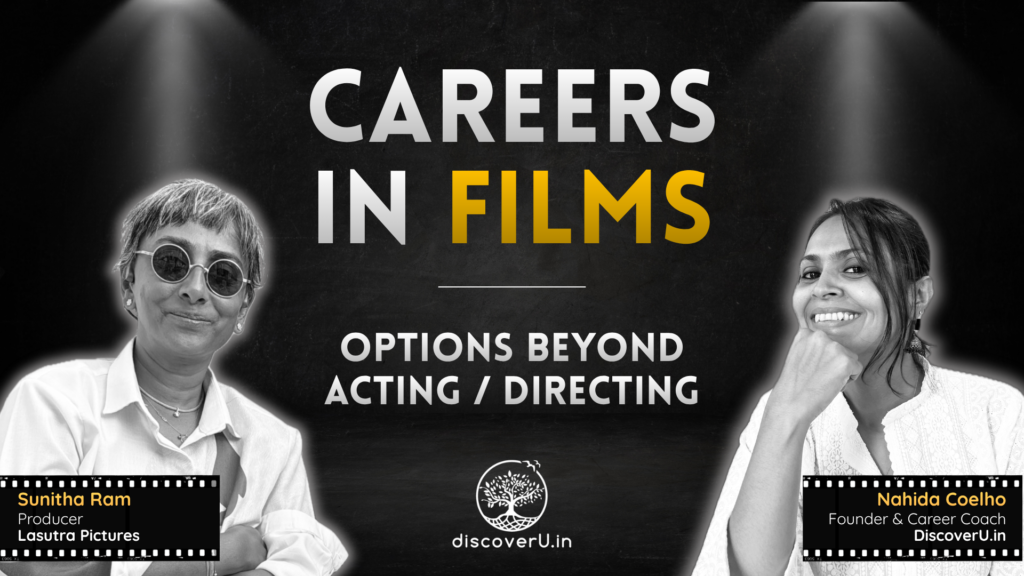
With over two decades of experience across feature films, OTT projects, advertising campaigns, tourism productions and international co-productions, Sunitha Ram has worked on several well-known projects, including Taare Zameen Par, Dhobi Ghat, Zindagi Na Milegi Dobara, The Archies and 120 Bahadur. Her experience offers a closer look at the many career opportunities within filmmaking—and the skills required to succeed behind the scenes.
In this conversation with DiscoverU, Sunitha discusses the realities of film production, how aspiring filmmakers can research career options, the importance of discipline and communication, the role of AI in filmmaking, and why sustainability needs to become part of everyday production practices.
“Production, like I said, is a jack of all trades. You need to know everything to be able to deal with any situation.”
Q & A with Sunitha Ram
What does a typical day look like for a producer, particularly during the most demanding phase of a project?
People often imagine that the most stressful day for a producer is when the shoot is happening. In my experience, the most demanding period is usually the two weeks before the shoot begins. Whether it is a short-form project or a feature film, this is when the producer needs to work the hardest so that the rest of the journey becomes relatively smooth. We are creating films and advertising projects almost out of thin air. Someone may say, “We want to shoot in a desert,” but that could mean Rajasthan, Dubai or somewhere else entirely. Narrowing down those possibilities and turning an idea into a workable plan is a team effort. During this period, I work long hours and make sure that I am present for every important meeting and discussion. I also organise team huddles across departments and try to anticipate what the next ten days will look like. I generally focus on four essential aspects of a project: the budget, the shooting schedule, the production schedule and the overall world of the film. By “world,” I mean the locations, cast, costumes and all the other elements that come together to create the visual and practical environment of the story. Looking at these four areas gives me a bird’s-eye view of the project and helps me prioritise what needs to happen next. Everyone is usually under immense pressure at this stage. People need more time or more money, but neither is always available. I believe that an executive producer needs to become the voice of calm and reason during this period. The job is to break the work into phases, decide what needs immediate attention and postpone what can be addressed later. It is also important to keep the main producer involved so that they can see how the creative vision is taking shape. I make sure the core team meets every morning, often before the rest of the production world begins its day. These meetings help build trust, clarify responsibilities and create a rhythm for the team. Once the shoot begins, everyone becomes occupied with their own departments, so the pre-production period is the best opportunity to ensure that important decisions are taken quickly and collectively.
How did you find your way into film production, and was it always part of your career plan?
Film production was not really a defined career option when I was starting out. Twenty years ago, most things simply came under the broad category of filmmaking. Once you entered the industry, you could gradually figure out which area suited you. I was always interested in advertising and media, partly because my father encouraged all of us to explore that space. I never felt an instinctive calling to become a writer or director, but I also never saw creativity and logistics as separate things. At that time, we believed that almost everything we did was creative because every decision contributed to the final creative outcome. I was naturally quite logical and process-oriented, so production felt like a good fit. Once I entered the industry, I realised that producing required a little bit of knowledge about everything, as well as a strong understanding of money and resources. That combination really excited me.
How did your postgraduate studies in Social Communications Media influence your approach to storytelling and production?
My postgraduate diploma in Social Communications Media from Sophia College had a significant influence on me. I believe it is a valuable course for anyone interested in media because it focuses not only on how we communicate but also on the impact of that communication. The course covered areas such as radio, television, print, journalism and public relations. All these forms of media are ways of speaking to the world, and with that comes a responsibility to think about what we are communicating and how we are communicating it. The course did not simply teach us how to write an article or prepare a press release. It encouraged us to become responsible human beings who understood the effect of our work. We discussed issues such as gender discrimination and the subtle ways in which it exists around us. Once you develop that awareness, it becomes difficult to switch it off. Whether you are writing an article, creating a film or putting out a press release, you become more conscious of how you are presenting something to the world. You also become more accountable for the messages and representations you create. That sense of responsibility has stayed with me throughout my career.
“You have to continue to be responsible human beings for whatever you’re contributing into the world.”
Your work spans advertising, feature films, OTT projects, tourism campaigns and international productions. Was that breadth deliberate, or did it evolve over time?
I was very fortunate to work with some excellent production houses and on challenging projects across different formats. I began in advertising with Prahlad Kakar at Genesis Films, and I was fortunate to work with Prahlad and Mittali at Offspring Films for the first few years. That experience helped me realise that I had an aptitude for production and could be trusted with responsibility. At Genesis, we were taught that we had to be dependable. You could not let the team down, and you had to be someone others could rely on. I think that foundation was extremely important. There is also a natural curiosity in the creative industry. When you work in advertising, you may want to try feature films, and when you work in feature films, you may want to return to advertising. I was lucky that I was allowed to explore different formats and then return to my original space. A turning point came when I got the opportunity to work as a costume designer on an international production being shot at Ramoji Film City. I knew very little about costume design, but Prahlad encouraged me to take the opportunity and assured me that I had a place to return to. That gave me the confidence to take the risk. The experience opened my eyes to how international productions functioned. I observed their systems, reporting structures, schedules, budgets and communication processes. Later, I had the opportunity to work on Taare Zameen Par for Aamir Khan Productions, which marked the beginning of my long-form journey. My experience in feature films then helped me manage large tourism campaigns, where logistics and coordination are particularly important. Each project gave me new knowledge, and over time, the different experiences began to complement one another.
The word “producer” is often misunderstood. What is the difference between a producer, co-producer, executive producer and line producer?
Conventionally, a producer is associated with the money behind a project or the person responsible for organising the finances. Sometimes the money may come from a financier who is not directly involved in filmmaking. A main producer then decides which project to support, identifies the creative team and begins building the project. Historically, one person often handled most of these responsibilities. However, as productions became more complex, it became necessary to divide the work and create a stronger structure around the finances and operations. This is where roles such as co-producer, executive producer and line producer became increasingly important. Depending on the project, there may be a need for all these roles or only some of them. An executive producer or line producer may be responsible for monitoring the budget, managing schedules, overseeing logistics and keeping the main producer informed about how the project is progressing. The objective is to ensure that the project moves from point A to point B without unnecessary delays or cost overruns. This structure also allows the main producer to step back and make creative decisions. For example, they may decide to add a scene or sequence because they believe it will improve the storytelling. If the producer is already deeply involved in every operational detail, such decisions become more difficult. A strong production structure allows someone to monitor the practical aspects while the main producer retains the space to think about the larger creative and business picture.
What does production management involve when you are working with hundreds of crew members and challenging locations?
Managing a crew of 300 people is not unusual in Indian productions, but it is still a major responsibility. I often compare it to organising a large wedding, except that the planning begins long before the actual event and involves many more moving parts. You need to know exactly how many people are working on the project, where they need to be, what they need to do, how they will travel, where they will eat and how their day will unfold. Even determining the exact number of people can be difficult. There may be additional local crew members, support staff or people who join temporarily. We also need to plan for food, accommodation, transportation, payments and basic comfort. Everyone should know where they need to go, where they can eat, where they can rest and what their responsibilities are. A great deal of production management comes down to communication. Every department must understand its own role as well as how it connects with the others. The crew also changes from one project to another, so you are constantly building new teams and creating trust. When we worked in Ladakh, for example, we took time to orient the cast and crew about the terrain, the climate and the importance of respecting the location. We also discussed wastage and resource conservation. When people understand the context of a place and the impact of their actions, they become more responsible. Good production management is not just about getting the work done. It is also about making sure that people are comfortable, informed, respected and able to do their jobs well.
How has technology changed communication on film sets, and what challenges has it created?
Technology has certainly made communication faster, but faster does not always mean better. Earlier, when we did not have email or WhatsApp, information was communicated through more structured systems. Today, we may have several WhatsApp groups and receive multiple updates every few minutes. The problem is that important information can get lost in the volume of messages. Someone may send an update repeatedly, and the person receiving it may assume that another version will arrive soon and stop paying attention. That becomes dangerous when the information is actually important. We now need systems to ensure that a communication has been received, acknowledged and acted upon. I believe that communication must be handled with professionalism, whether you are working on an advertising film or a feature film. Instead of sending incomplete information several times, it is better to spend two hours getting the information right, checking it and then sending it out clearly. This creates value in the communication. The same principle applies to production documents, schedules and budget updates. We have moved from a world where a project document might be on version three to one where it could be on version thirty. That makes it even more important to maintain clarity and discipline.
What advice would you give to students and young professionals who want to enter the film industry?
My first recommendation is to research the industry properly before entering it. Many people know about acting, directing or cinematography, but they may not realise how many other roles exist within filmmaking. Take a film that you enjoy and study its opening and closing credits. You can also use platforms such as IMDb, Wikipedia or other online resources to understand what different professionals do. Look at roles such as production designer, art director, set decorator, property master, script supervisor, line producer and executive producer. Research the differences between them and understand how they contribute to the final film. This simple exercise can help you identify where your interests and abilities might fit. Perhaps you enjoy designing spaces, organising things, taking photographs, working with clothes, planning travel or managing information. These interests may connect to specific roles within the film industry. If you already have skills in graphic design, CAD or data analysis, you should not necessarily present yourself only as an intern. You can introduce yourself through the skills you already possess while remaining open to learning. Of course, internships are useful, but you should not enter the industry without an identity or an understanding of what you can contribute. The industry is expensive, and there is less room than before for people to learn everything through trial and error on the job. Research should be your first lesson.
“Take any film that you like. See every single credit, opening and end. That is your lesson number one.”
Is formal film school more important than internships and practical experience?
I believe formal education and practical experience both have value, but they serve different purposes. A good film school can teach you the craft, the history of cinema and the structure of the industry. It can give you a systematic understanding of different departments and help you develop a common language with other professionals. If you are serious about filmmaking, you should know how the industry evolved—from the early formats of film to the transition from 8 mm and 16 mm to 35 mm and eventually digital production. You should understand the history of filmmaking rather than focusing only on the equipment or department you want to work in. At the same time, formal education cannot teach you every practical skill. In production, you may suddenly need to understand screen printing, transportation, local permissions, costumes or a technical requirement on a set. I once had to arrange screen printing for a number of football jerseys within three days, even though the usual process took two weeks. I had to understand the screen printer’s work, break down the process and find a way to make it happen. That knowledge helped me repeatedly in later projects. So, formal education can give you a foundation, while practical exposure and independent research help you develop the flexibility needed in the real world. You should not assume that you can simply join as an intern and figure everything out. Come prepared, understand the industry and then use practical experience to deepen your knowledge.
What qualities stand out when you meet someone who is new to the film industry?
Research is extremely important. If someone is meeting me for an interview, I would expect them to know something about my work and the projects I have been involved in. It is surprisingly rare for candidates to research the person they are meeting. Beyond that, I look for some quality or interest that makes them distinctive. Perhaps they are excellent at presenting spreadsheets, analysing data, travelling, organising or learning new technology. They do not have to be perfect at something, but they should have a genuine interest and the willingness to develop that ability. I also expect people to stay current. They should know what is happening in the world, understand new technologies and watch films or behind-the-scenes material to see how productions are made. In production, being street-smart is useful because you often need to solve unexpected problems quickly. However, I also increasingly look for a sense of morality and an understanding of how someone treats other people. The film industry is highly collaborative. You may grow within a team, but you should not do so at someone else’s expense. Respect, communication, teamwork and a sense of responsibility are just as important as technical skills.
How do you see AI affecting film production? Is it a threat or an opportunity?
AI is here to stay, so we need to learn how to work with it. It will certainly challenge conventional filmmaking and traditional production processes. The important thing is to start integrating it into our daily workflows before it completely changes the way we work. For example, AI can help with preparing sheets, drafting emails, organising information and tidying up certain documents. However, these outputs still need to be checked and personalised. AI may be able to help create a budget or organise information, but that does not mean it understands the realities of a particular production. On a larger scale, AI is already being used to create shots and visual sequences that would once have been expensive, difficult or dangerous to produce. Technology can give filmmakers new ways to visualise an idea. I do not believe we should approach AI only as a tool that will eliminate people. We need to use it to create newer and more imaginative things. If we continue making the same things in the same ways, then technology may eventually replace some of those processes. But if we use AI to expand our creative thinking, it can help us develop new possibilities. It is also important that Indian filmmakers engage with these tools so that our own cultural, ethical and creative perspectives become part of the technology we use.
What led you to champion ethical and sustainable production practices?
Sustainability began for me with simple observations from everyday life. At home, many people separate their waste or try to reduce consumption. But once we step outside, we sometimes behave as though someone else will take care of everything. During our tourism productions and other location-based projects, I began to notice how much waste could be created through unnecessary travel, excess food, additional equipment and poor planning. If we were shooting in a remote location, we might order extra food because we were afraid it would run out. We might arrange multiple vehicles because we were not sure how many people would need transport. We might carry three versions of something because we had not made the decision early enough. All of this adds up. A turning point came during a production in Nepal, after the country had experienced a major earthquake. We were organising transport, and the local line producer questioned why one person needed one car. He explained that fuel was scarce and that people could easily share transport. It was a simple but powerful reminder that our decisions have consequences beyond the production itself. From then on, I began encouraging teams to reduce unnecessary travel, share vehicles, use online meetings when possible and think carefully about what we were consuming. Sustainability is not only about doing the right thing environmentally. It can also reduce costs and improve efficiency. In recent projects, we have encouraged teams to ask every day: What can we eliminate? What are we wasting? What can we do more efficiently? When you reduce waste, you often save money as well.
“Sustainability is not just about doing the right thing. Eliminating waste on a film set saves money and makes the whole production more efficient.”
What do you wish someone had told you when you were starting your career?
I wish someone had told me earlier that there was a career path within filmmaking. I was fortunate to work on several wonderful projects, but I often moved from one project to another because of the challenge and excitement of the work. I did not always take the time to visualise where I wanted my overall career to go. Today, I would encourage young professionals to think about their career path after the first few years. Understand where you want to be and what you want to achieve. I would also strongly recommend developing expertise in two different areas. For example, you could be interested in editing and production, costume and makeup, writing and editing, or directing and another technical skill. Filmmaking contains so many different worlds, and there is no need to limit yourself to a single identity. A dual skill set can make you more adaptable and give you more opportunities as the industry changes. You may move into one area for a while and return to another later. That is perfectly acceptable. The important thing is to remain open, keep learning and think beyond one fixed career path.
What final advice would you like to share with people who want to work in filmmaking?
Enjoy filmmaking. If you have a story to tell, the tools available today make it possible to begin creating your own work. But creativity alone is not enough. Research, communication and discipline are essential. Understand the industry, learn about the different roles, communicate clearly and develop the ability to work with people. It is an exciting time to enter filmmaking because there are so many tools and opportunities available. Use them thoughtfully, stay curious and find your own way of contributing.
Key Learnings
Production is more than managing money
Producers and production teams coordinate budgets, schedules, people, logistics and creative requirements to keep a project on track.
The hardest work happens before the shoot
The weeks leading up to production are crucial for making decisions, reducing uncertainty and preparing teams for the work ahead.
Research is the first step into filmmaking
Studying film credits on IMDb, Wikipedia and other platforms can help aspiring professionals understand the industry’s many career pathways.
Creativity and logistics go together
Successful production requires both creative understanding and the ability to manage resources, timelines and unexpected challenges.
Build more than one skill
Combining two areas of expertise can help professionals remain flexible and discover new opportunities as the industry evolves.
Professional communication matters
Clear, structured and timely communication is essential when large teams, multiple departments and constantly changing information are involved.
AI should support new ideas
AI can improve workflows and expand creative possibilities, but filmmakers must use it thoughtfully rather than simply reproducing existing work.
Sustainability can improve efficiency
Reducing unnecessary travel, food, equipment and resource consumption can benefit both the environment and the production budget.
Respect is a professional skill
Teamwork, ethical behaviour and consideration for others are essential qualities in a collaborative industry like filmmaking.
Conclusion
Sunitha Ram’s career offers a practical look at the many opportunities available behind the scenes of the film industry. Her journey highlights the importance of curiosity, preparation, discipline and the willingness to explore different roles and formats. From understanding production management to researching film credits, adapting to AI and reducing waste on set, her advice extends well beyond filmmaking.
For anyone considering a career in film production, the first step is to look beyond the obvious roles, understand where their skills fit and begin building a foundation of knowledge, experience and professional discipline.
Sunitha Ram is a producer and executive producer with over two decades of experience across feature films, OTT projects, advertising campaigns, tourism productions and international co-productions. Her body of work includes projects such as Taare Zameen Par, Dhobi Ghat, Zindagi Na Milegi Dobara, The Archies and 120 Bahadur. She has also worked extensively on large-scale productions involving complex logistics, diverse teams and challenging locations. Alongside her production work, Sunitha advocates for ethical, responsible and sustainable practices within the film industry.