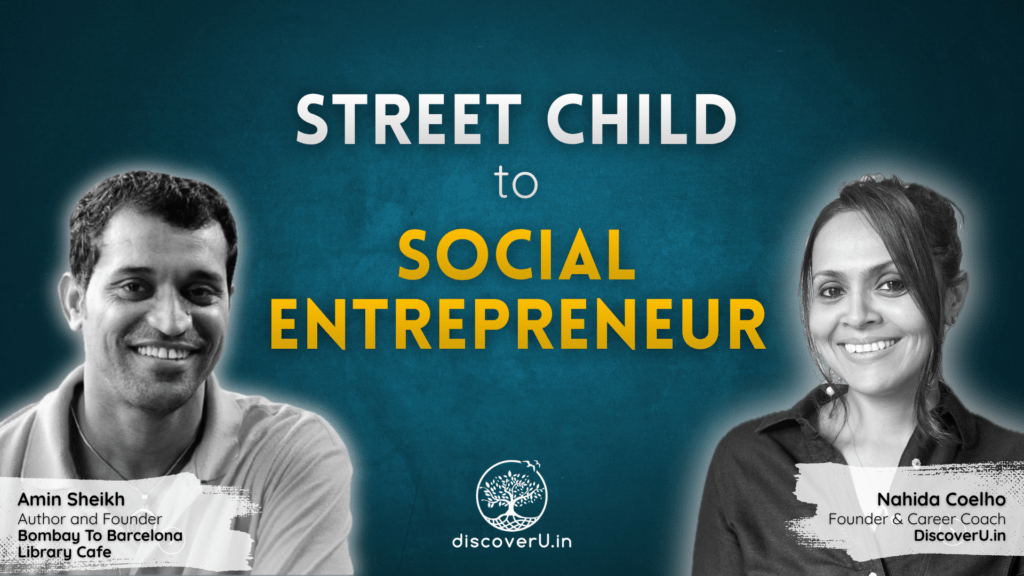
Amin Sheikh’s story is about what can happen when someone believes in you—and what you can do when you extend that belief to others. After spending part of his childhood on the streets of Mumbai, Amin found guidance, opportunity and a sense of belonging through people who helped him imagine a different future. Today, he is the founder of the Bombay to Barcelona Library Café, a social enterprise that creates employment opportunities for young people from vulnerable backgrounds. In this conversation with DiscoverU, Amin reflects on the people who changed his life, the lessons he learned through travel, the value of practical skills, and why success means more than building a comfortable life for yourself.
“There are two things you can do in life. One, you run behind the money or do something beautiful, the money runs behind you.”
Q & A with Amin Sheikh
You run the Bombay to Barcelona Library Café, Little Gurus Nest School and the Street Angels Foundation. What does a normal week look like for you today?
I currently live in Kazakhstan, so I travel to Mumbai regularly, depending on what is happening and what I need to take care of. When I visit, I look after the paperwork, payments and other responsibilities that come with being the founder and proprietor of the café. But the day-to-day running of the café is managed independently by our boys and girls. I am very proud of them because they have reached a point where they can run the place without me being physically present. It has taken more than sixteen years of work, patience and support from many people to build what we have today. The café came first, and after several years, we began exploring how we could do more through education. One of the girls who worked with us had a real interest in teaching. She would teach children who came to the café from the streets, and I could see her passion. When she suggested opening a school, I believed she could do it. We built the school in twenty days using a loan of ₹20 lakh, and she took responsibility for running it. Later, someone helped us understand how we could structure the school as a foundation and use the café’s business model to support more work. I may not have had a formal education or the knowledge to understand all these systems, but good people came into our lives and guided us. Every kind of knowledge makes a project stronger.
You mentioned children living on Mumbai’s streets. Having experienced that life yourself, what do you think people need to understand about their circumstances?
I know the pain because I have lived it. I would never blame a child for the circumstances they are born into. Children do not ask to come into this world. If parents bring a child into the world, I believe they have a responsibility to care for that child, help them when they fall and give them the support they need to stand up again. I grew up in a family that struggled financially. My parents did not have a proper home or stable circumstances, and there was a lot of conflict. When I was five, I began moving from one place to another and working. My first job was in a bakery, where I earned one rupee a day. I struggled to carry the trays because they were bigger than me, so I moved to a tea shop. I cleaned glasses, carried tea and worked in difficult conditions. People would sometimes mock me or hit me while I was doing my job. I was a child, and I remember wondering why people treated me that way. What I experienced was not simply a lack of money. It was a lack of safety, dignity and someone who would step in. There are children facing similar circumstances today. We often talk about progress in terms of bigger homes, more money and better lifestyles, but we also need to ask what kind of life we are creating for children who have very little. A child’s circumstances should not decide their entire future.
“The children are the flower of the garden.”
How did your time at Sneha Sadan orphanage influence the direction your life took?
Sneha Sadan changed my life. It gave me a home and a sense of belonging that I had not experienced in the same way elsewhere. Children from different religions and cultural backgrounds lived together, but we did not spend our time judging one another. We knew that we had food to eat, a place to sleep and people to play with. We fought sometimes, as children do, but our differences did not define our relationships. Father Placid was one of the greatest influences in my life. He saw that I was going in the wrong direction and continued to guide me. I later returned to the streets for a period, and I could have gone down many different paths. I cannot say what would have happened to me without the people who stepped in. Father Placid, Sister Seraphine, Eustace Fernandez and many others gave me opportunities, guidance and love. I have met many people who have achieved things for themselves, and that is understandable. But I often ask a different question: what have you done for others? One person believing in me changed the direction of my life. That experience has stayed with me, and it is a large part of why I want to create opportunities for other young people.
You have often spoken about how travel changed your outlook. What happened when you first visited Barcelona?
My first trip to Europe was in 2003. At the time, I was working as a driver for Eustace Fernandez, a well-known artist. I had learned a great deal from him, including how to interact with people, and I was gradually learning English. I eventually became a tour guide and built my own travel-related work. One Christmas, Eustace asked me what I wanted as a gift. I was surprised because I was used to receiving his old clothes or things he no longer needed. When he insisted that I tell him what I wanted, I said I wanted to go to Barcelona. He was shocked. He could not understand why a driver who did not have much money would want to travel to Spain. It hurt me because he had asked what I wanted, and I had simply answered honestly. Eventually, he gave me a Christmas card confirming that we would travel to Barcelona the following April. I was overwhelmed. As a child, I had never owned a bicycle; we used to rent one just to watch aeroplanes take off. Now I was going to fly to another country. When I arrived in Barcelona, what struck me most was that I did not see children living on the streets in the way I had seen them in Mumbai. The streets were cleaner, and I noticed how people from different walks of life could sit in cafés without being judged. The experience made me realise that the world was much bigger than the place I had grown up in. It changed how I saw people, society and what might be possible.
“The world is beyond this.”
How did that experience eventually lead to the idea of the Bombay to Barcelona Library Café?
After travelling, I began asking myself what would happen to people like me who never received the same opportunities. I had been fortunate to meet people who believed in me, helped me learn and allowed me to experience a different world. But what about the other children who had grown up on the streets? I had built a more comfortable life for myself, yet I felt that something was missing. I wanted to do something that would give young people opportunities similar to the ones I had received. Many people advised me to settle down, get married and enjoy the life I had built. But I could not stop thinking about this idea. I wrote to Oprah Winfrey because I had seen her help people turn their dreams into reality, although I never received a response. Later, a friend from Spain told me how she had written and sold a book to help fund electricity for hospitals she had built. That made me think: if she could write a book to support her work, why was I waiting for someone else to build my café? I had never written a book before. I did not know how to write one properly, but I decided to start anyway. Two friends, Aina and Elia, helped me bring the book to life, including its design. It took a long time, and finding a publisher was difficult. Eventually, I published the book myself and began selling it on the streets and at traffic signals in Mumbai. I spent hours every day speaking to people and asking them to buy it. It took six and a half years to sell 26,000 copies. That effort helped turn the idea of the Bombay to Barcelona Library Café into a reality.
What makes the Bombay to Barcelona Library Café different from a conventional business or charity?
For me, the café was never designed simply as a business model. It came from a personal question: what happens to young people who may not have formal education but still have abilities, interests and a desire to work? I was never a good student, and I never went to college. But I could clean, wash, drive, cook, speak to people and build relationships. These are skills too. I wanted to create a place where young people could develop those abilities, earn a living and discover what else they could do. The café provides employment and practical experience for young people from vulnerable backgrounds. They work in different roles, including cleaning, cooking, serving and public relations. Some have also explored their interests outside the café. One of our girls became a fashion designer and created clothes to sell there. Another pursued modelling, while one of our boys performs rap music at events. The café is a workplace, but it is also a place where people can explore their potential. We do not want someone to believe that one job defines the rest of their life. If they want to become something else, we want to help them find a way to do it. The café is built around humanity, equality and respect. We do not treat people as if they are simply our staff. We work as a team. That is the kind of environment I wanted to create: a place where people can earn, learn, contribute and feel that they belong.
What have you learned about the value of practical skills and the role of formal education?
Education is important, but we must understand that people learn and demonstrate ability in different ways. I struggled with formal education, and I know what it feels like to be judged because of that. At the same time, I have seen young people who may not have had access to good schools develop excellent practical skills when they receive the right opportunities. In a café, for example, you need people who can prepare good food, serve customers, communicate, work with others and treat people with kindness. These are not insignificant abilities. They are essential to making a workplace function. A degree can open doors, and I would never say that education does not matter. But the absence of a degree should not mean that a person is denied the chance to prove what they can do. We need to recognise different strengths and give people opportunities to develop them. When young people come to us, we try to understand what they want to do and what they can learn. Some may discover that they enjoy hospitality, while others may find an interest in fashion, music or another field. The important thing is to give them a starting point. I believe every child should have the freedom to decide what they want to become, rather than being pushed into a life chosen by their parents, neighbours or society.
“You should become what you want.”
What does it mean to give young people an opportunity while also teaching them responsibility?
Opportunity and responsibility have to go together. I can provide a young person with a job, support and a chance to learn, but they also need to understand the effort involved in building a life. Nothing simply falls from the sky. Whatever you receive, you should appreciate the work that went into creating it, whether that work was yours or someone else’s. Over the years, I have helped arrange housing for some of the young people connected to the café. I have taken loans, put my own property at risk and worked hard to make those opportunities possible. People have also helped through donations and other forms of support, and the café has generated money that contributes to the work. When a young person receives an apartment, however, I do not want the story to end there. I want them to understand that they have a responsibility to help someone else when they are in a position to do so. If someone has helped you stand on your feet, you can help another person stand on theirs. That is how opportunity can continue from one person to another. We often think, “I have what I need, so why should I worry about someone else?” But the lives of other people are not separate from our own. If we want a better society, we have to take some responsibility for one another.
You often talk about belief. How important is self-belief when someone is trying to build a different future?
Somebody needs to believe in you, but it also has to begin within you. If you do not believe in yourself, you cannot expect the whole world to believe in you. I know this because I have experienced people judging me throughout my life. I was judged as a street child, as someone who lived in an orphanage and as a driver. People often made assumptions about what I could or could not do. If I had accepted every judgement and given up whenever someone said my idea was impossible, I would not be sitting here today. Belief does not mean that everything will happen quickly or easily. It takes time, hard work and help from other people. I needed people who believed in me, and I am grateful for every one of them. Now I try to offer the same belief to the young people who work with us. They may make mistakes, struggle or leave and return. We have to give people time to learn. One of our boys, Robin, has left the café many times and returned asking for another chance. He has difficulties that other workplaces may not understand, but we discovered that he has a real strength in public relations. That is why I believe we should look beyond a person’s difficulties and try to understand their abilities. When people are given a chance and someone believes in them, they may achieve much more than anyone expected.
“If you do not believe, don’t ask the world to believe in you.”
How do you define success, and why is giving back such an important part of your work?
For me, success cannot be only about earning money, owning a home or building a comfortable life. Of course, people need to earn a living, and there is nothing wrong with wanting a better life for yourself and your family. But I think we also need to ask what we are doing for other people. The people who helped me did not simply give me money. They gave me their time, guidance, trust and opportunities. They helped me understand that I could do more than the circumstances I came from might have suggested. I want the young people who work with us to experience that too. I want them to earn, build skills, explore their interests and become independent. I also want them to understand that the support they receive can be passed forward. We cannot take our possessions with us forever. What remains is the difference we make in other people’s lives. I have seen how much can change when someone chooses to help rather than judge. That is why I keep returning to the idea of humanity and equality. We can build a society where everyone thinks only about themselves, or we can build one where we think about ourselves and others. I believe the second is a much more beautiful way to live. Before we leave this world, we should try to give something back.
What concerns you about the younger generation today, and what would you like them to understand?
I think young people today have access to enormous amounts of information, but they also face distractions that can make it harder to connect with the people around them. Phones and social media have their uses, but I worry when people spend time together without actually speaking to one another. We need conversations, relationships and real experiences. I also think we need to appreciate what we have. Sometimes we take our food, homes, education and opportunities for granted because they are part of our everyday lives. We should be grateful, respectful and aware that other people may not have the same things. I believe travel is important because it allows you to see different ways of living and understand that the world is not limited to your own experience. I also believe children should learn values through what adults do, not only through what adults tell them. If we want young people to be respectful, kind and responsible, we must demonstrate those qualities ourselves. We cannot expect them to become good examples if we are not willing to be good examples for them. Parents should also understand that every child is different. They should not constantly compare one child with another or force them to follow a path that does not suit them. Give children guidance, help them when they fall and allow them to grow according to their strengths.
“If we can’t be a good example, we do not have the right to ask the youth to be a good example.”
What does education mean to you beyond classrooms, degrees and qualifications?
Education is important, but for me, the real foundation is humanity and equality. We must respect people regardless of their profession, income, background or level of education. Think about it: when there is garbage outside your home, somebody has to collect it. When something in your house breaks, you may need a carpenter. Every profession serves a purpose, and we should respect the people who do that work. I have experienced what it is like to be judged because of the work I did or the circumstances I came from. I do not want other people to experience the same judgement. Education should help us become more understanding, not give us reasons to look down on others. It should help us recognise that every person has dignity and that everyone deserves an opportunity to learn, work and contribute. We can teach a child many subjects, but if that child grows up believing that some people are less worthy of respect than others, we have missed something important. Humanity is not separate from education. It is at the heart of it.
Key Learnings
One person’s belief can change a life
A mentor, teacher or employer who recognises your potential can open doors you may never have imagined. When you have the opportunity, offer that belief to someone else.
Practical skills have real value
Cleaning, cooking, communication, customer service and relationship-building are valuable workplace skills. Formal qualifications matter, but they are not the only way to demonstrate ability.
Exposure expands what feels possible
Meeting different people and experiencing different places can challenge your assumptions and help you imagine new opportunities for yourself.
Build opportunities, not just a business
A business can do more than generate income. It can provide employment, practical experience, confidence and a platform for people to discover their strengths.
Opportunity comes with responsibility
Support can help someone get started, but hard work, accountability and a willingness to learn are essential. Passing opportunities forward helps create lasting change.
Self-belief takes time to build
Progress may be slow, and other people may doubt your plans. Keep learning, accept guidance and give yourself time to turn an idea into reality.
Respect every profession
Every kind of work contributes to society. A person’s dignity should not depend on their job title, educational background or financial position.
Be the example you want others to follow
Young people learn from the behaviour they see around them. Respect, kindness, gratitude and responsibility are values adults must demonstrate, not merely demand.
Success includes giving back
Building a life for yourself matters, but helping others find their own opportunities can create an impact that lasts beyond your personal achievements.
Conclusion
Amin Sheikh’s journey from childhood on Mumbai’s streets to founding the Bombay to Barcelona Library Café is a reminder that a person’s beginnings do not have to determine their future. His story also shows how much difference one person’s belief can make—and how that belief can grow into opportunities for others. Through employment, practical learning and a culture built around humanity and equality, Amin is helping young people develop their skills and imagine new possibilities. His message is relevant not only to aspiring entrepreneurs, but to students, professionals, parents and anyone who wants to build a meaningful life: work hard, believe in yourself, respect others and remember to give back.
Amin Sheikh is the founder of the Bombay to Barcelona Library Café, a social enterprise in Mumbai that provides employment and opportunities for young people from vulnerable backgrounds. Drawing on his own experiences of childhood hardship, the support of mentors and the perspective he gained through travel, he has worked to create a space where young people can develop practical skills, earn a living and explore their potential. His wider work includes initiatives connected to education and social support, including Little Gurus Nest School and the Street Angels Foundation.